Articles
The Tomb of Homer and the Island of Ios
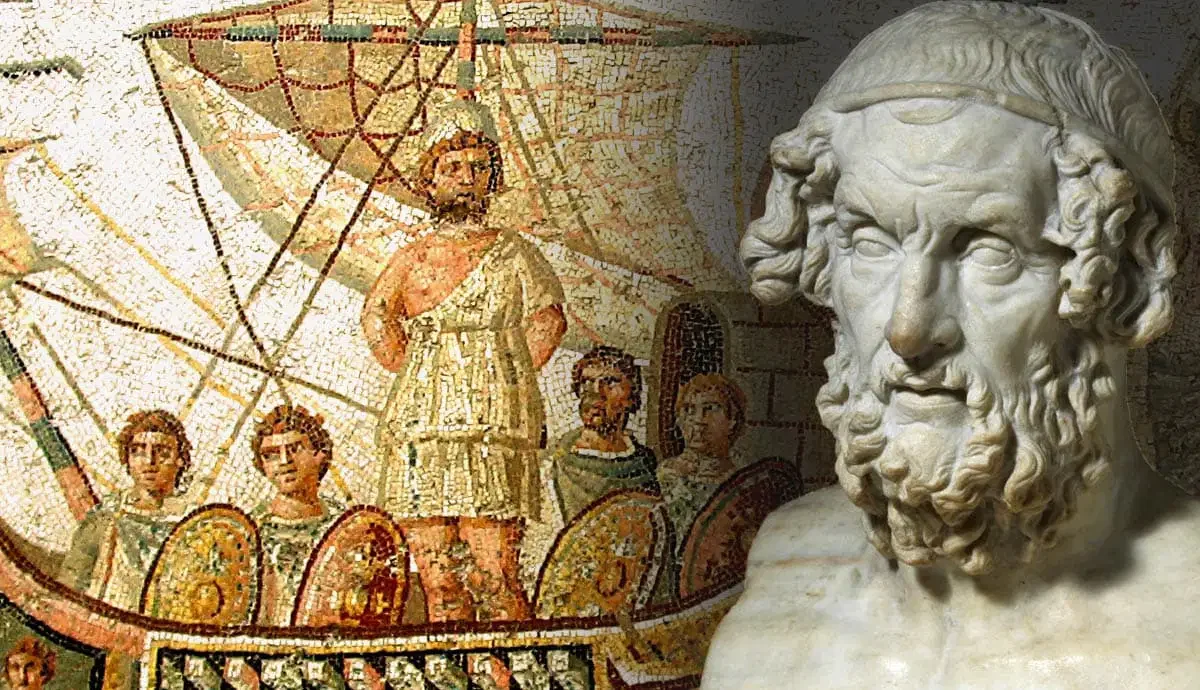
Ios is one of the Cyclades group of islands, with ferry services from numerous locations, including Naxos, Paros, Santorini and Athens (Piraeus) itself. I arrived by ferry from Mykonos, taking around two hours for the journey and stayed at the affordable and welcoming Avri Pension in early October, which was a short walk from the quayside with its numerous restaurants and bars, although several were closing down for the winter.
Having visited Athens, Santorini and Mykonos, I felt it was time to visit a quieter island a little off the beaten track and headed for Ios. although it still has the reputation of a party island in the peak season. The island itself is rugged and hilly, rising to 2372 feet (723 metres), depending on your source, with stunning vistas from the roads overlooking the Aegean.
Truth be told, I didn’t find out about Homer’s Tomb until I arrived. There is no public transport to the tomb, but there are guided tours available, or you could book a taxi, but I decided to hire a car for two days, not forgetting to take photos of any dings that the vehicle may have had.
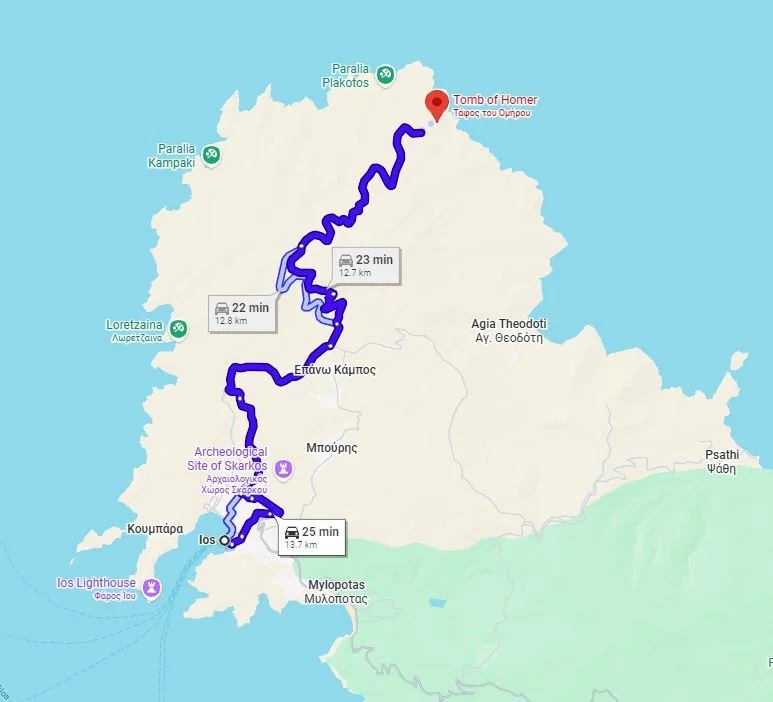
The route on the map estimates around twenty five minutes to drive the eight miles (13 km) or so to Plakoto, the location of the tomb, from the port of Ios, but will probably take longer if you stop and take photographs, or if you have to wait for the occasional goat herder and his charges to pass by. The journey wasn’t so much a pilgrimage, which implies a spiritual imperative, more a paying of respects to nothing less than a founder of western literature and civilisation.

The road to Plakoto
That this is authentically the Tomb of Homer, and indeed, that Homer is even buried on Ios, is still a matter of some conjecture. It may be that the structure is a cenotaph, a monument in honour of Homer whose remains lie elsewhere, is a possibility.
The tomb itself is in disrepair, there is no sarcophagus and the lintel over the doorway is missing, indeed, there isn’t even a roof. The floor plan is visible with what looks like an inner structure, which may have housed a sarcophagus, and there are numerous cairns that have been assembled by visitors as their personal memorial to Homer. But don’t let all of this put you off, it is the ambience of the place, as much as anything, that you are visiting.

The Tomb of Homer
Christopher Nolan’s movie Ulysses went on general release in the summer of 2026. I haven’t seen it, so I can’t comment on it, except to say the main criticisms are well-known - incongruous casting, lack of emotional depth, Hollywood grandiosity amongst others. Emily Wilson, translator of Nolan’s prime source says “…I would be ashamed to have written any part of this script”, but as a scholar of Carl Jung, I couldn’t help but add my two penneth (cents) to the discussion.
For mythologist Joseph Campbell, who was influenced by Jung, the poem is the prime exemplar of the “monomyth”, common to many cultures, geographical locations and from ancient times to the present day. Examples would include The Epic of Gilgamesh, the Legend of King Arthur and the Grail Quest, William Shakespeare’s The Tempest, Percy Shelly’s Prometheus Unbound, James Joyce’s Ulysses. In Arabic literature the Hero’s Journey is known as Rihlat al-Batal and includes Attar of Nishapur’s The Conference of the Birds which exemplifies the Islamic Sufi Quest, and also the anonymous folk tales of the One Thousand and One Nights with Scheherazade and Sinbad. In the movies, we could include Harold Ramis’ Groundhog Day, Terry Gilliam’s The Fisher King, Lasse Hallström’s The Shipping News, Peter Jackson’s Lord of the Rings and George Lucas’ Star Wars, although I’m not sure the latter addresses the core meaning of the myth.
The protagonist in all of these is, of course, male and so is there a female equivalent? Maureen Murdock, a Jungian analyst, in The Heroines Journey: Woman’s Quest for Wholeness asks the same question. Whereas the male has to bring his soul, the feminine aspect of his psyche to fruition, with females it is the male figure of authority, the animus, and ultimately the Self (as with males, admittedly) which has to be integrated. The only example of this I am aware of in the movies is Guillermo del Toro’s Pan’s Labyrinth, young Ofelia’s downfall being greed.
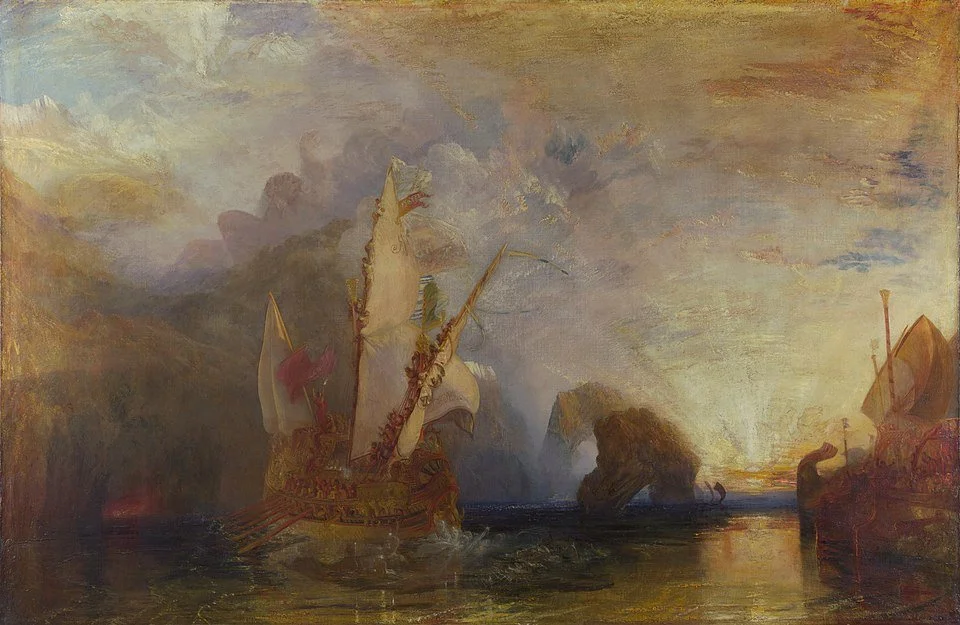
Ulysses Deriding Polyphemus, JM.W. Turner, 1829, The National Gallery, London
The Trojan War is over, and Ulysses’ mind turns towards home and Penelope, his faithful wife, and his kingdom of Ithaca. The poem is a work of imagination and a song of experience, the journey home is concerned with the restoration of Self and the ascent of the soul, through education, to its full realization.
Ulysses is aided by the wise goddess Athena, and, like Goethe, the divine feminine leads him higher. He encounters the anima, the unconscious feminine component of the male psyche in several guises; there is seductive Calypso, who holds him sexual captive for seven years, the transformative sorceress Circe, and the Sirens, with their false promise of ultimate truth. He has to maintain his psychic equilibrium between the destructive forces of Scylla and Charybdis and forego the narcotic of the Lotus-Eaters. He blinds the one-eyed giant Polyphemus and, in so doing. incurs the wrath of the sea god Poseidon who will make his journey as difficult as possible, and he has to journey to Hades, the Underworld, to the depths of the unconscious to confront whatever lies there, including an emotional meeting with his dead mother, Anticleia.
And so, ten years after setting out, Ulysses finally arrives home as a beggar and dressed in rags. With the help of his son, Telemachus, he dispatches Penelope’s unwanted one hundred and eight suitors who have taken over the royal palace. These are, after all, just atavistic desires and impulses that have no business in trying to seduce Penelope, the sacred feminine. So the thrill and passion of the union of opposites is achieved and Ulysses and Penelope can rule as King and Queen.
So, as nutshells go that’s pretty small, but I hope you get a little more out of Nolan’s film if and when you watch it.

Mikro Avelos from the Tomb
When I visited the tomb, the scene was blessed with beautiful late afternoon light angling in beneath the low, dark clouds and it felt as if you were perched at the edge of the known world, surrounded by transcendent mysteries.